How Industrial Fans Move Air
Industrial fans move air by creating a pressure difference. The rotating impeller transfers energy to the air, raising pressure on the outlet side and creating lower pressure at the inlet. Air then flows from the higher-pressure area toward the lower-pressure area through a defined system. The fan type, impeller design, speed, and system resistance determine the resulting airflow and pressure.
Axial Fans
Working Principle and Airflow Direction
Axial fans move air parallel to the fan shaft. Rotating blades create a pressure difference between the intake and discharge sides, pulling air through the fan and pushing it forward in a straight path. This design delivers high airflow with relatively low static pressure, making axial fans a practical choice for open or lightly restricted airflow systems.
For a broader selection guide, see our overview of AC axial fans for industrial cooling.
Typical Applications: Cabinets, Condensers, and Ventilation
Axial fan types are commonly used where steady air movement and compact installation matter:
-
- Electrical cabinets: Remove heat from control panels, servers, and electronic enclosures.
- Condensers: Move air across heat exchanger coils in refrigeration and HVAC equipment.
- Ventilation systems: Support general air exchange in equipment rooms, workshops, and commercial spaces.
- Industrial cooling: Provide direct airflow where the system has limited duct resistance.
For standard equipment cooling, our AC axial fan product range offers a practical starting point for selecting the right fan size and configuration.
External Rotor Fans
Motor-in-Hub Design Advantages
An external rotor fan places the motor inside the fan hub, allowing the rotating assembly to stay compact and balanced. This design helps reduce the overall installation depth and keeps the motor protected within the wheel structure. It also supports a clean airflow path and makes these fan types practical where equipment space is limited.
Condenser and Heat Pump Applications
External rotor fans are commonly selected for condenser and heat pump systems that need steady airflow through a coil. They fit well in outdoor HVAC equipment, refrigeration units, and ventilation assemblies where compact packaging and reliable air movement matter. Our external rotor fan product range provides options for industrial ventilation and heat-transfer equipment, including applications that require a space-efficient axial fan design.
Centrifugal Fans
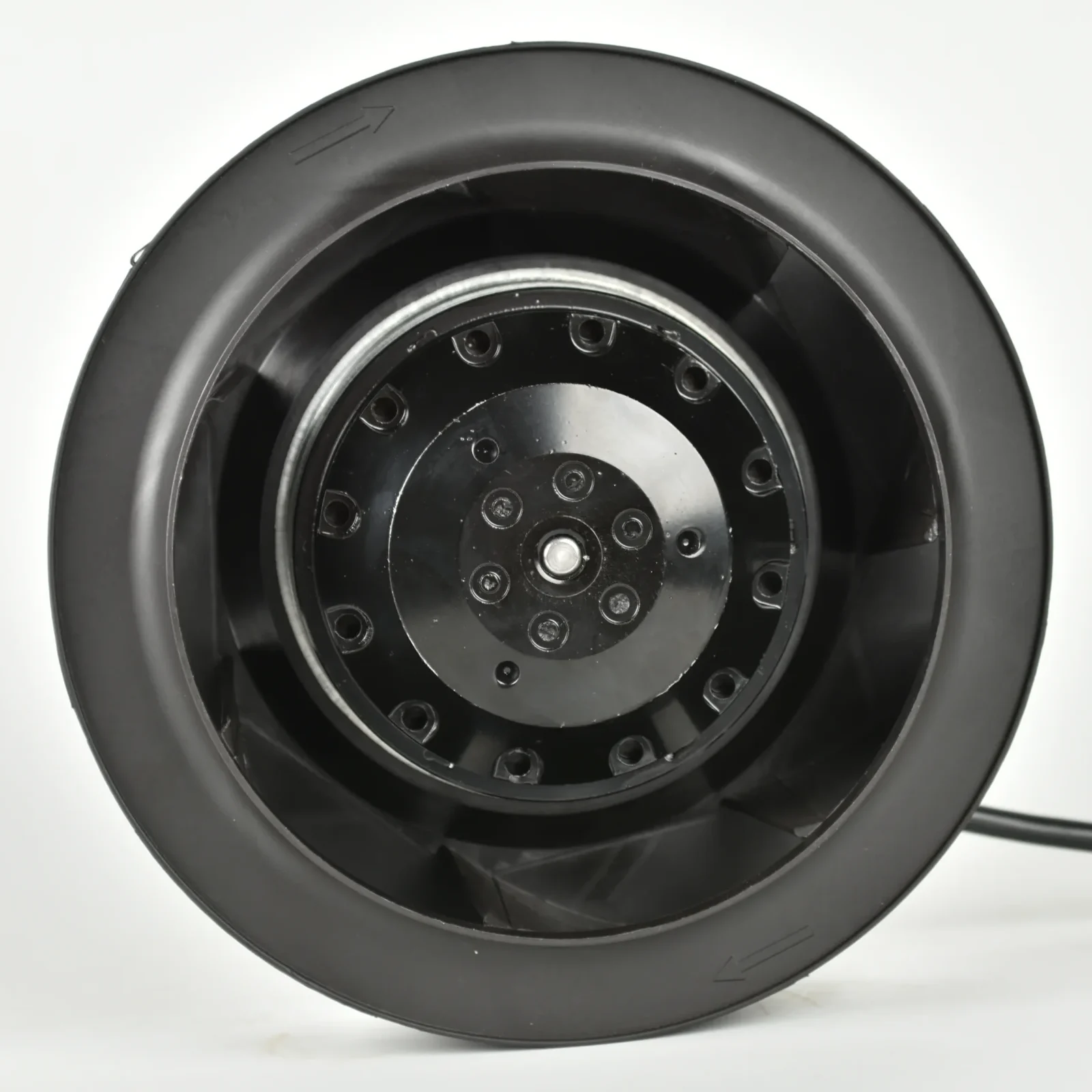
Centrifugal fans draw air into the center of the impeller and discharge it at a right angle. This design is well suited to systems that need stronger static pressure to move air through filters, ducts, coils, or other resistance.
Forward- and Backward-Curved Impellers
-
- Forward-curved impellers use closely spaced blades to deliver high airflow in a compact design. They are commonly used where space is limited and system resistance is moderate.
- Backward-curved impellers generally provide more efficient operation and better control under higher resistance. They are a strong choice for continuous-duty air movement and demanding ventilation systems.
Our centrifugal fan product category includes options for different airflow, pressure, and installation requirements.
High-Pressure Applications: AHUs, Dust Collection, and Drying
Centrifugal fans are often selected for air handling units (AHUs), dust-collection equipment, industrial drying systems, and ducted ventilation. Their pressure capability helps maintain useful airflow when the system includes long duct runs, filters, dampers, or process equipment. For compact industrial installations, a 180 mm AC centrifugal blower fan can support targeted air movement where installation depth and reliable operation matter.
EC Fans
AC Power with a DC Motor Core
EC fans use AC power from the building supply while the motor operates through integrated electronic commutation. This design combines simple installation with the controllability of a DC motor. Depending on the fan and control system, speed can be adjusted to match changing airflow demand, helping equipment avoid unnecessary full-speed operation.
When the Higher Cost Is Worth It
The higher upfront cost of an EC fan can make sense when the fan runs for long hours, airflow demand changes frequently, or energy use is a major operating expense. EC fan types are especially practical for equipment that benefits from precise speed control, compact integration, and reduced power consumption during partial-load operation. For short-duty or fixed-speed applications, a conventional AC fan may remain the more economical choice.
Comparison Table: Type vs Airflow vs Pressure vs Depth vs Use
The right choice among the main types of fans depends on available space, required airflow, system resistance, and operating conditions. Use this comparison as a practical starting point:
| Fan type | Airflow profile | Pressure capability | Installation depth | Common use |
|---|---|---|---|---|
| Axial fan | High airflow with a straight-through path | Low to moderate | Usually compact | Electrical enclosures, condensers, and general ventilation |
| External rotor fan | High airflow with an integrated motor-and-impeller layout | Low to moderate | Compact to moderate | Condensers, heat pumps, and outdoor air movement |
| Centrifugal fan | Moderate to high airflow | Moderate to high | Moderate to deeper | AHUs, dust collection, and drying equipment |
| EC fan | Adjustable airflow with efficient speed control | Depends on the fan design | Varies by configuration | Energy-conscious HVAC, cooling, and OEM equipment |
For enclosure cooling, a compact axial design may be the most practical option. Systems with filters, ducts, coils, or other airflow restrictions may need a centrifugal fan with higher pressure capability. EC models are often worth considering when variable speed control, lower energy use, or long operating hours are important. For enclosure-related planning, our electrical enclosure accessories guide provides relevant application context.
Which Type Does Your Application Need?
Choose among the main types of fans in this order: available space, system resistance, then energy efficiency.
-
- Start with space: Use an axial fan when air must move straight through a shallow cabinet, condenser, or ventilation opening. Choose a centrifugal fan when the fan must fit into ductwork or a compact air-handling system.
- Check resistance: Low-resistance airflow usually suits axial fan types. Filters, coils, ducts, dampers, and dust-loading add resistance and may require a centrifugal design with stronger static-pressure performance.
- Compare efficiency: When the fan runs for long hours, an EC fan can help reduce energy use through efficient motor control and speed adjustment. For simpler, shorter-duty applications, a standard AC fan may be the more practical choice.
- Match the environment: Confirm airflow, static pressure, voltage, temperature, noise limits, and available depth before selecting a model.
For equipment protection, the fan should also work with suitable accessories, such as a properly sized industrial metal fan guard.
Frequently Asked Questions About Fan Types
What are the main types of fans?
The main fan types include axial fans, centrifugal fans, external rotor fans, and EC fans. Axial fans move air along the motor shaft, while centrifugal fans redirect air outward through the impeller. External rotor and EC designs describe motor construction and control features that can be used with different fan arrangements.
Which fan type provides higher pressure?
Centrifugal fans are generally suited to applications with higher system resistance, such as air handling units, dust collection, and drying equipment. The required pressure depends on duct length, filters, coils, dampers, and other airflow restrictions.
When should I use an axial fan?
An axial fan is a practical choice when the system needs high airflow with relatively low resistance. Common uses include cabinet cooling, condenser ventilation, heat pump equipment, and general air movement.
What is an external rotor fan?
An external rotor fan places the motor rotor around the stator within the fan hub. This compact arrangement can help reduce installation depth and integrate the motor directly with the impeller, making it suitable for condenser and heat pump equipment.
Are EC fans worth the higher initial cost?
EC fans may be worth the added cost when the application requires variable-speed control, frequent operation, or lower energy use over time. They are especially useful when airflow needs to adjust with temperature, load, or system demand.
How do I select the right industrial fan?
Start with the available installation space, required airflow, and system resistance. Then check voltage, power, operating environment, noise expectations, and control requirements. Matching the fan to both airflow and pressure is more reliable than selecting by size alone.
Share Your Application for Fan Type Recommendations and Samples
Send us your application details—including available space, airflow needs, system resistance, voltage, and operating environment. We will recommend the right type of industrial fan and arrange a sample for evaluation. For high-volume cooling, our 210 × 210 × 70 mm AC axial fan is one relevant option to review. Submit your requirements for a product recommendation and quotation.