What Is CFM? How to Calculate Airflow for Cooling Fans
When choosing a cooling fan, one of the first specifications you will see is CFM.
A fan may be rated at 50 CFM, 200 CFM, 500 CFM or even several thousand CFM. But what does CFM actually mean, and how much airflow does your application need?
In simple terms, CFM measures how much air a fan can move.
Understanding CFM helps you compare cooling fans, estimate ventilation requirements and select a fan that can provide enough airflow for control cabinets, HVAC equipment, refrigeration systems, industrial machinery and other applications.
In this guide, we explain what CFM means, how it is calculated and what factors you should consider when choosing a cooling fan.
What Does CFM Mean?
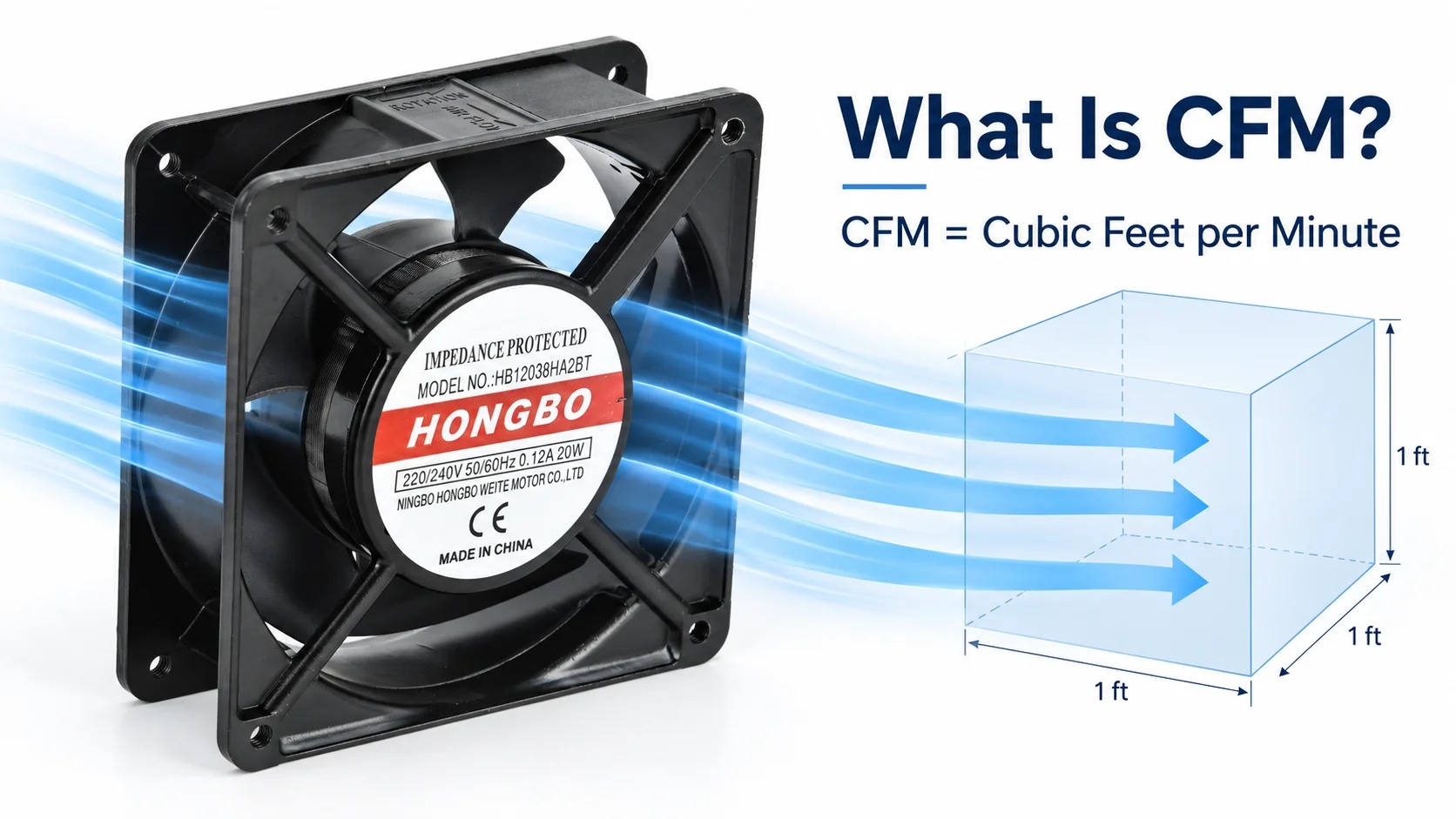
CFM stands for Cubic Feet per Minute.
It is a unit used to measure volumetric airflow — the volume of air moving through a fan or ventilation system every minute.
For example:
- A fan rated at 100 CFM moves approximately 100 cubic feet of air per minute under its specified test conditions.
- A fan rated at 500 CFM moves approximately five times that volume of air.
- A fan rated at 1,000 CFM is generally used for applications requiring much greater ventilation.
The higher the CFM, the greater the volume of air the fan can move.
However, higher CFM does not automatically mean a better fan.
The correct airflow depends on the size of the enclosure, heat generated by the equipment, airflow resistance and the required operating temperature.
What Is CFM in a Fan?
For a cooling fan, CFM tells you its airflow capacity.
It is one of the most important specifications when comparing:
- AC axial fans
- DC cooling fans
- EC fans
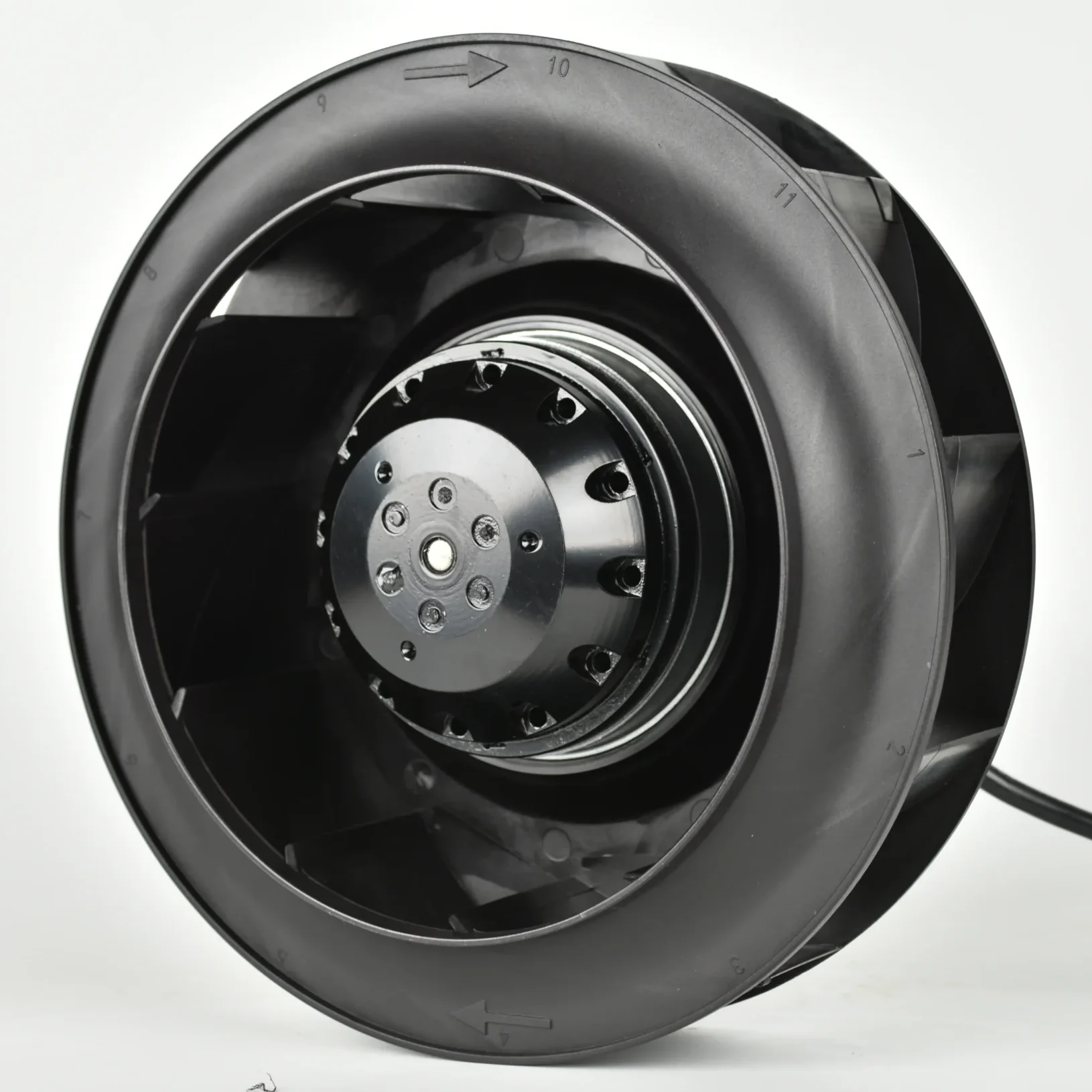
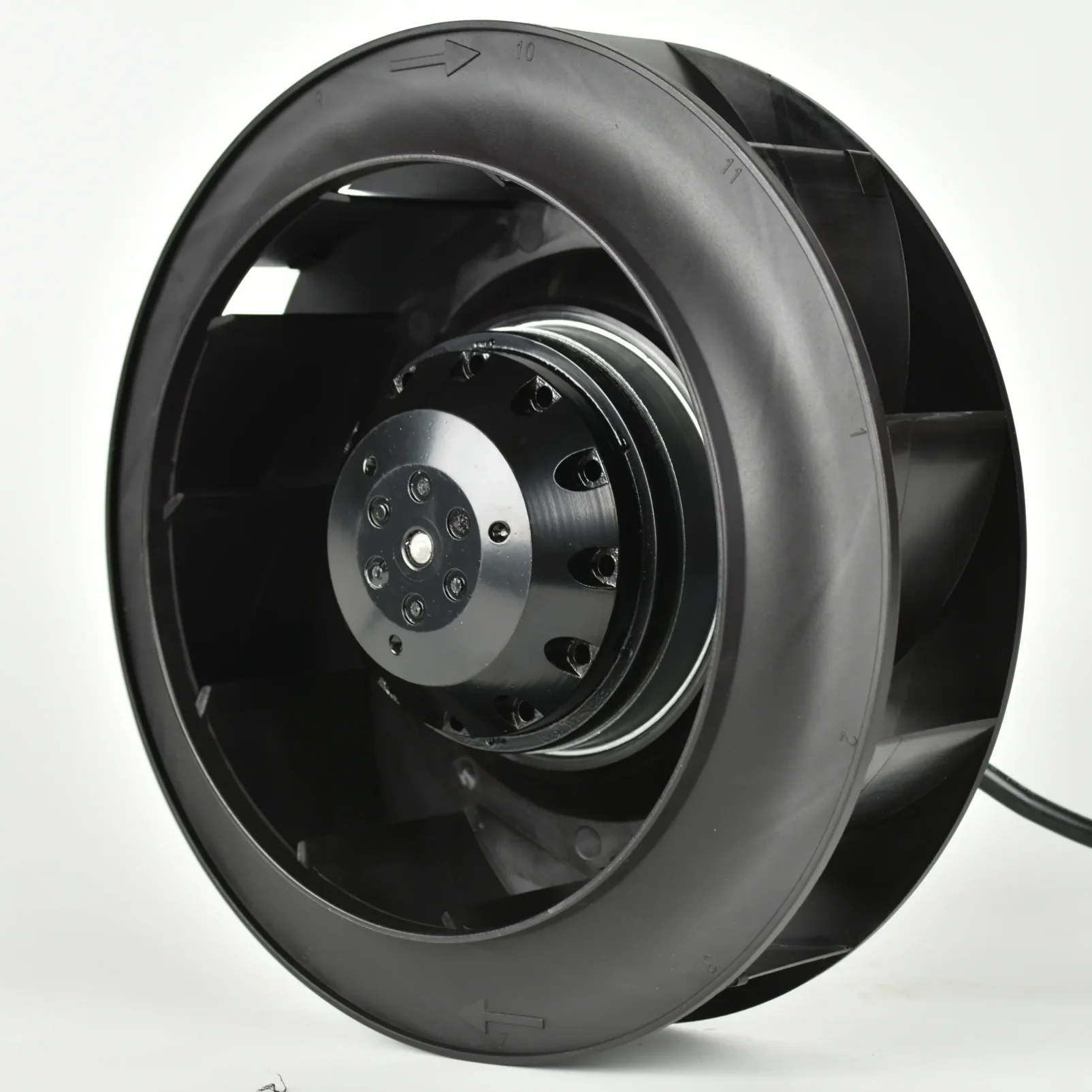
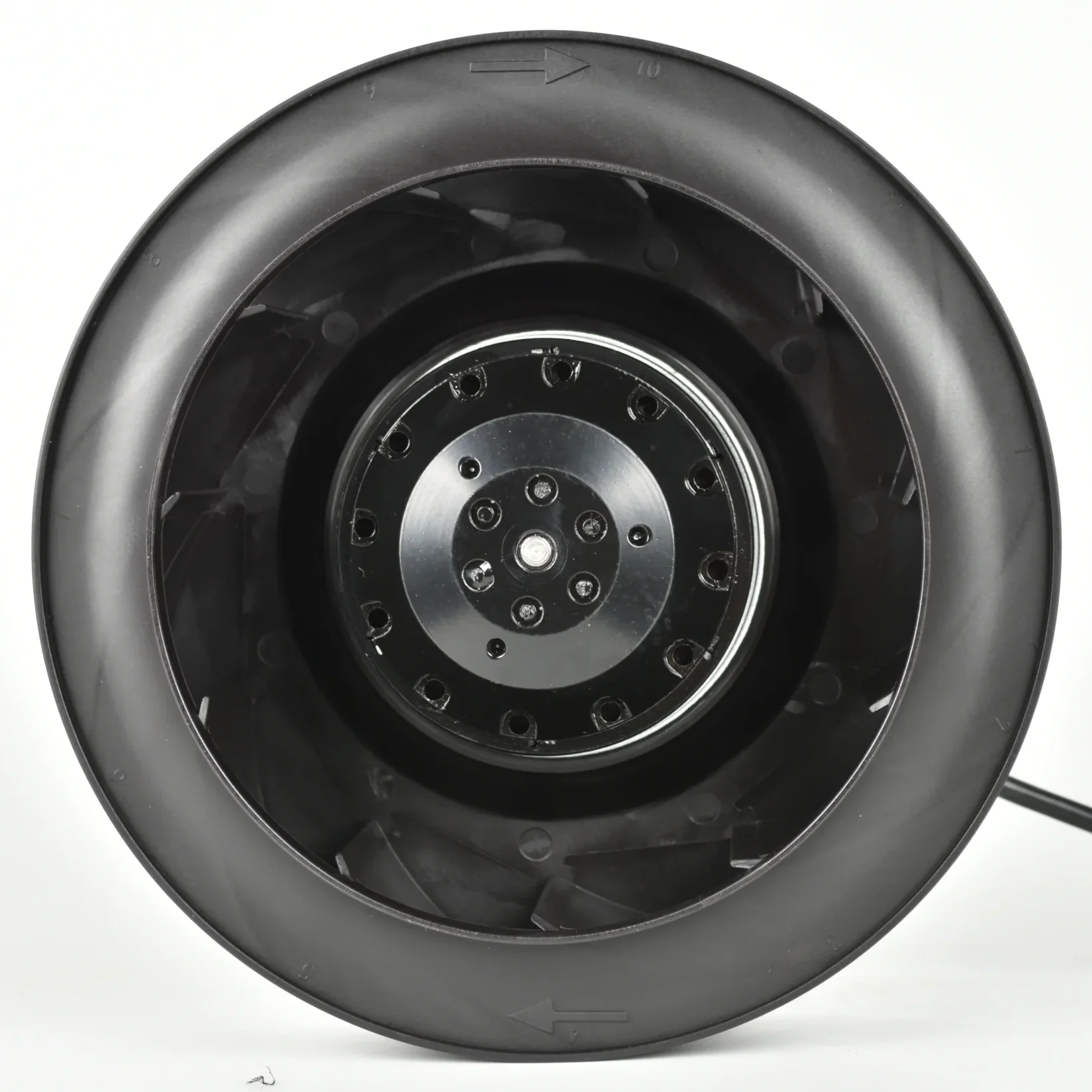
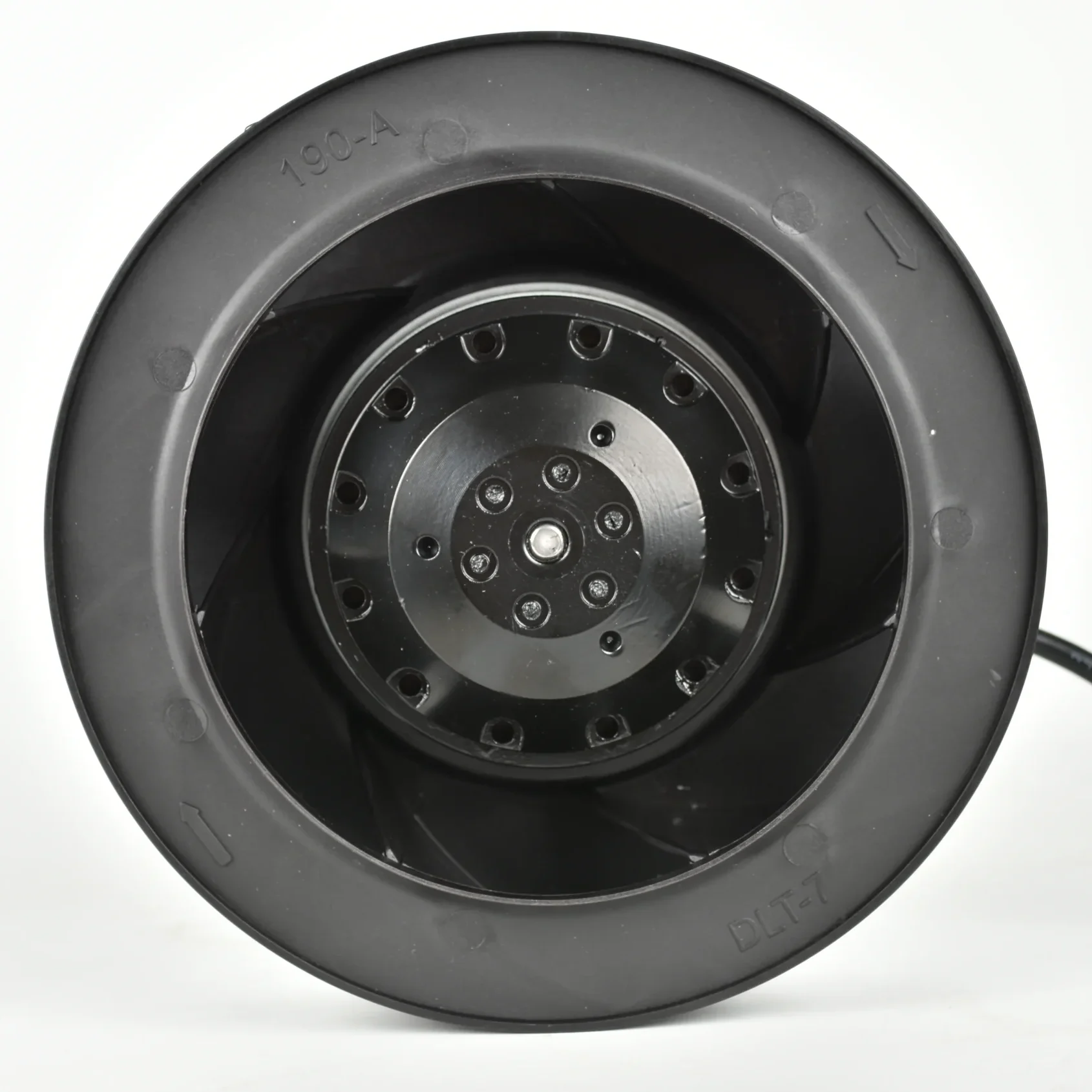
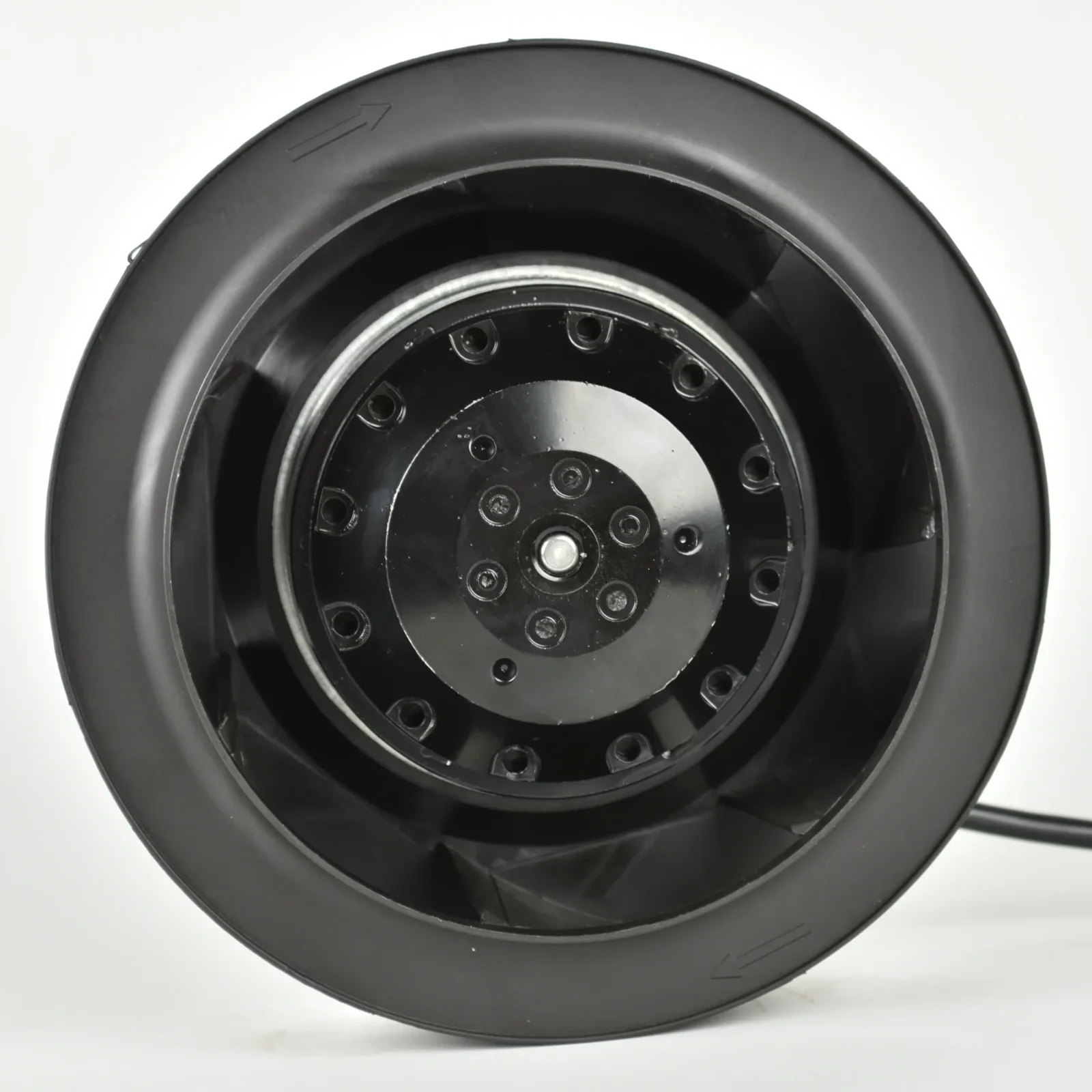
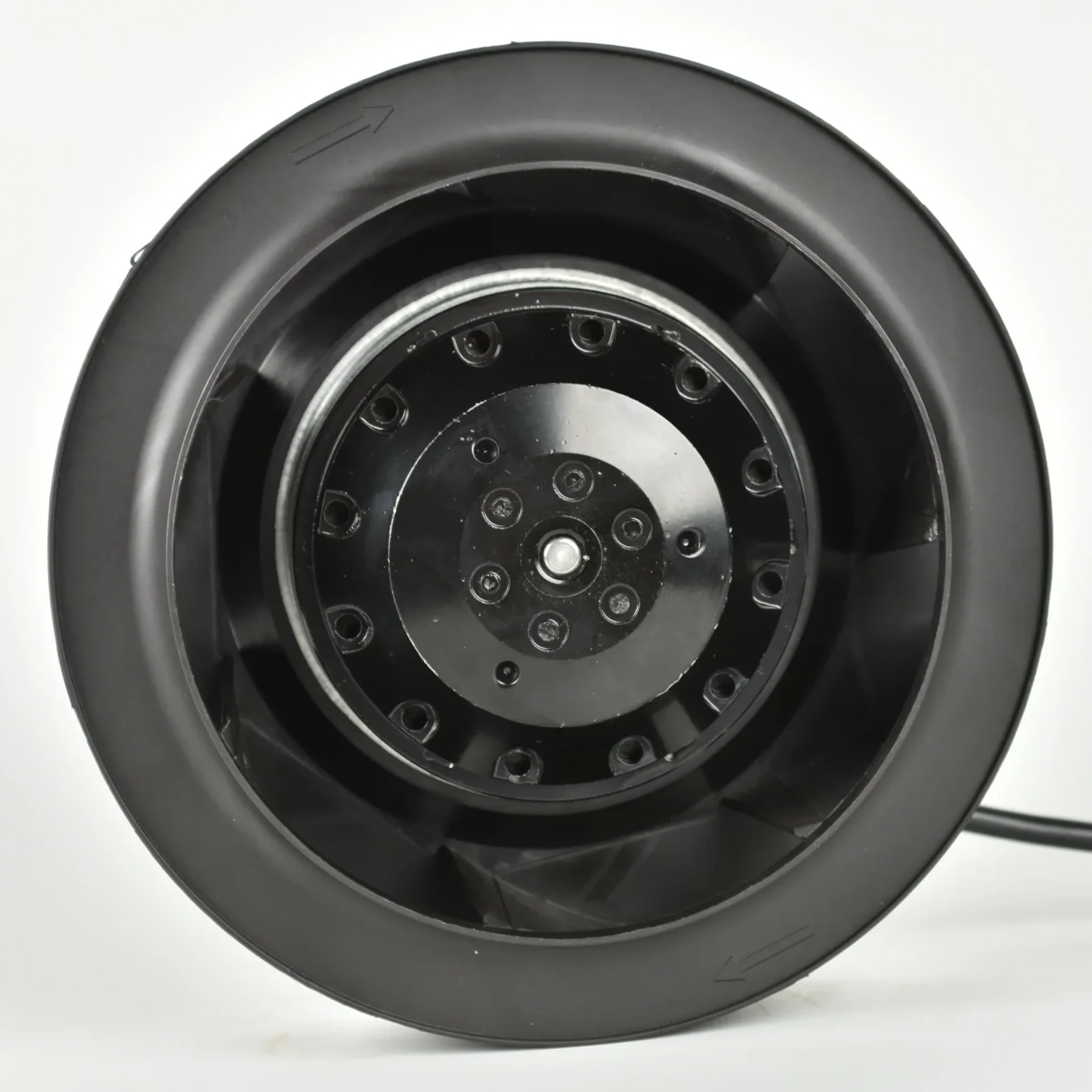
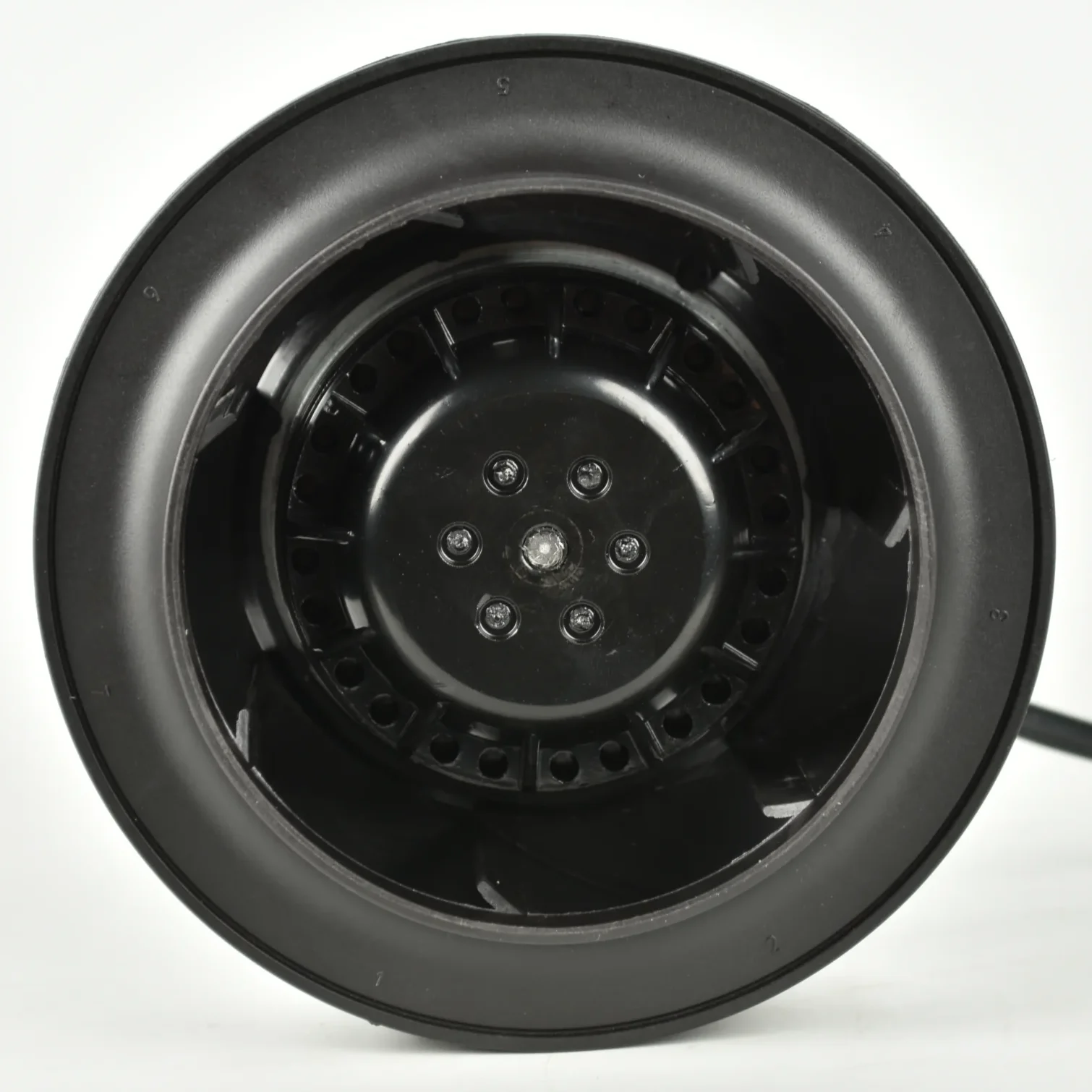
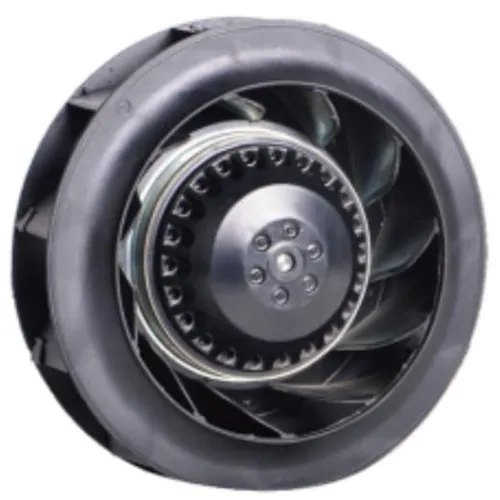
- Centrifugal fans and blowers
- External rotor fans
- Cabinet cooling fans
- HVAC fans
For example, two 120 mm axial fans may have the same physical dimensions but very different airflow ratings.
One may deliver:
90 CFM
while another delivers:
180 CFM
The higher-airflow model can move more air, but it may also have a different motor, blade design, rotational speed, power consumption, noise level and static-pressure capability.
This is why fan selection should never be based on CFM alone.
How Is CFM Calculated?
Airflow can be calculated from the cross-sectional area through which the air moves and the velocity of the air.
A simplified airflow formula is:
CFM = Air Velocity (FPM) × Area (ft²)
Where:
- CFM = Cubic Feet per Minute
- FPM = Feet per Minute
- Area = Airflow cross-sectional area in square feet
Example
Suppose air travels through a duct with a cross-sectional area of:
2 ft²
and the average air velocity is:
500 FPM
Then:
CFM = 500 × 2
CFM = 1,000
The airflow through the duct is therefore approximately:
1,000 CFM
In professional fan testing, airflow is normally measured using standardized laboratory equipment rather than estimated only from this simple calculation.
CFM to m³/h Conversion
CFM is widely used in the United States, while many countries use m³/h (cubic meters per hour).
A useful conversion is:
1 CFM ≈ 1.7 m³/h
For example:
CFM Approx. m³/h 50 CFM 85 m³/h 100 CFM 170 m³/h 200 CFM 340 m³/h 500 CFM 850 m³/h 1,000 CFM 1,700 m³/h You can also convert m³/h back to CFM:
CFM ≈ m³/h ÷ 1.7
For example:
500 m³/h ÷ 1.7 ≈ 294 CFM
This is useful when comparing fan specifications from manufacturers using different measurement systems.
How Much CFM Do I Need?
There is no single CFM value that works for every cooling application.
The required airflow depends mainly on:
- Amount of heat generated
- Maximum acceptable temperature
- Ambient temperature
- Size of the enclosure or space
- Airflow resistance
- Fan installation method
For simple ventilation applications, airflow is often estimated using the volume of the space and the required number of air changes.
For electronic cabinets and industrial equipment, the calculation is usually based more heavily on heat dissipation and allowable temperature rise.
Method 1: Calculate CFM Using Air Changes
For room or enclosure ventilation, CFM can be estimated using:
CFM = Room Volume × Air Changes per Hour ÷ 60
First calculate the volume:
Volume = Length × Width × Height
Example
Suppose a room measures:
- Length: 20 ft
- Width: 15 ft
- Height: 10 ft
The volume is:
20 × 15 × 10 = 3,000 ft³
If the application requires 10 air changes per hour:
CFM = 3,000 × 10 ÷ 60
CFM = 500
Approximately 500 CFM of airflow would be required to achieve 10 air changes per hour under ideal conditions.
Actual system requirements may be higher because filters, ducts, vents and other components create airflow resistance.
Method 2: Calculate Cooling Fan CFM from Heat Load
Industrial equipment often contains components that continuously generate heat.
Common examples include:
- Variable frequency drives
- Power supplies
- Transformers
- PLCs
- Servers
- Inverters
- Batteries
- Relays
- Industrial control electronics
In these applications, a cooling fan removes heated air and replaces it with cooler ambient air.
The airflow requirement therefore depends on both the heat load and the temperature difference you are willing to allow between the enclosure and ambient air.
As heat generation increases, more airflow is normally required.
Likewise, if the permitted temperature rise is very small, a higher airflow rate will usually be necessary.
For critical industrial applications, thermal calculations should consider actual equipment losses, ambient conditions, enclosure design and airflow paths rather than selecting a fan based only on enclosure dimensions.
CFM Is Not the Same as Fan Speed
CFM and RPM are related, but they measure different things.
CFM measures airflow.
RPM measures how fast the fan rotates.
A 3,000 RPM fan does not necessarily move more air than every 2,500 RPM fan.
Airflow also depends on:
- Fan diameter
- Blade shape
- Blade angle
- Number of blades
- Motor design
- Housing design
- Operating resistance
A larger fan running at a lower RPM can sometimes provide more airflow than a smaller fan operating at a higher RPM.
When comparing cooling fans, check the actual airflow specification rather than relying only on RPM.
CFM vs Static Pressure
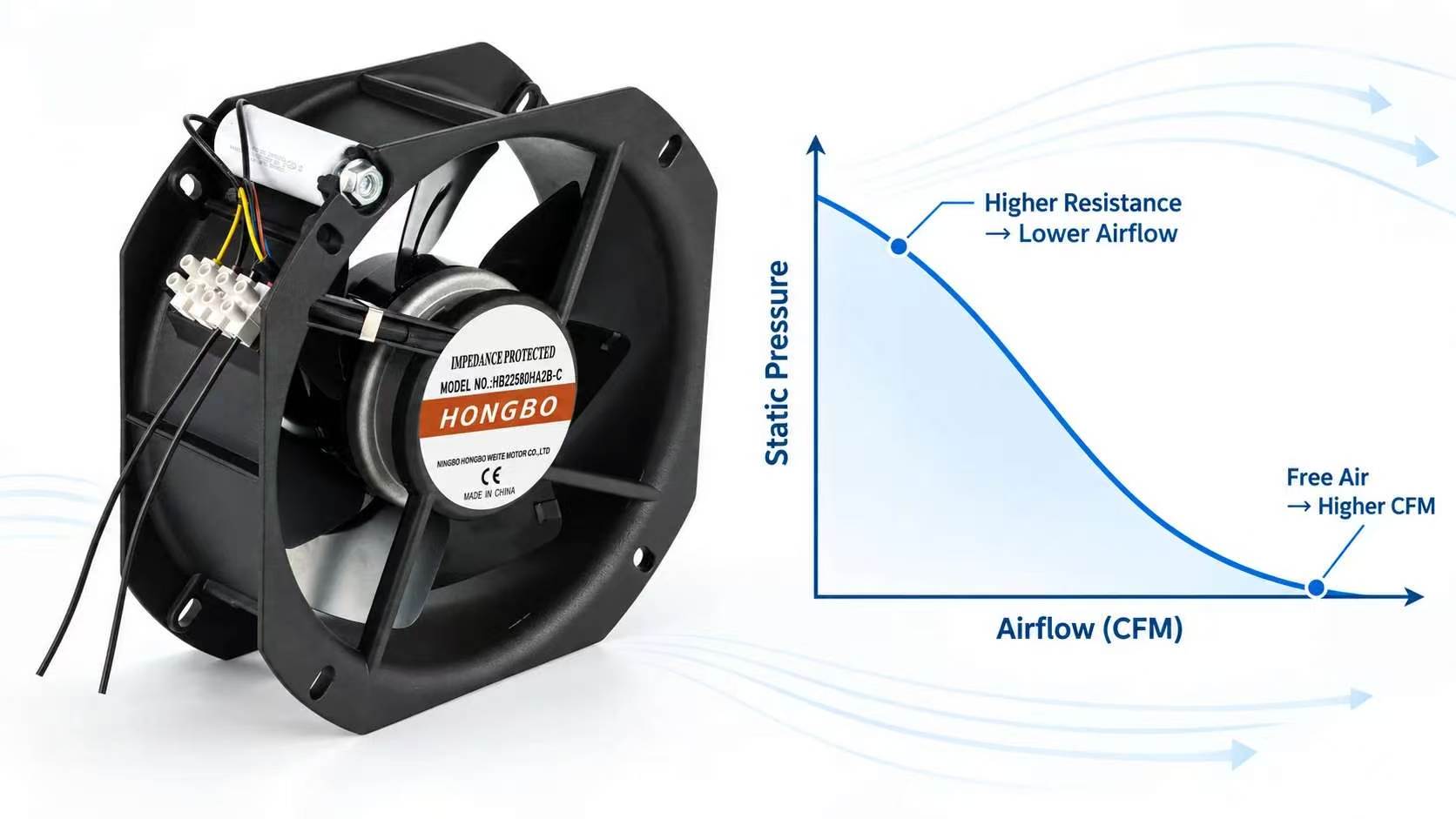
One of the most important things to understand when choosing an industrial fan is that CFM changes as airflow resistance changes.
A fan may produce high airflow when there is almost no resistance.
But once the fan is installed behind:
- Filters
- Grilles
- Heat exchangers
- Dense electronic components
- Long air ducts
- Narrow ventilation openings
the airflow can decrease.
This resistance is commonly represented by static pressure.
Because of this, professional fan selection normally considers both:
Airflow (CFM)
and
Static Pressure (Pa or in. H₂O)
rather than CFM alone.
Understanding a Fan Performance Curve
A fan performance curve shows the relationship between:
Airflow → CFM or m³/h
and
Static Pressure → Pa or in. H₂O
As system resistance increases, airflow generally decreases.
For example, a fan may provide:
300 CFM at free air
but significantly less airflow once it is installed in a system with filters, vents and internal components.
The actual operating point is determined by the interaction between the fan curve and the system resistance curve.
This is why two fans with similar maximum CFM ratings may perform very differently in a real machine.
Does a Larger Fan Always Have Higher CFM?
Generally, increasing fan size allows a fan to move more air, but fan diameter alone does not determine airflow.
For example, common industrial axial fan sizes include:
- 60 × 60 mm
- 80 × 80 mm
- 120 × 120 mm
- 150 × 150 mm
- 172 mm
- 200 mm
- 225 mm
- 250 mm
- 280 mm
A larger fan normally has the potential to generate more airflow because it has a larger air-moving area.
However, actual CFM also depends on the motor, fan speed, blade geometry and aerodynamic design.
Always compare the manufacturer’s performance data.
What CFM Should I Look for in an Industrial Cooling Fan?
Instead of simply selecting the fan with the highest CFM, start by identifying the airflow requirement of the application.
Consider the following questions:
1. How much heat does the equipment generate?
Equipment with high-power electronics generally requires greater airflow.
2. What is the ambient temperature?
A cooling fan cannot cool air below the surrounding ambient air temperature without additional refrigeration or heat-exchange systems.
3. How much temperature rise is acceptable?
A smaller allowable temperature difference generally requires more airflow.
4. Is there a filter or grille?
Filters increase resistance and can reduce actual airflow.
5. Does the air travel through a duct?
Long ducts, bends and narrow passages increase pressure loss.
6. Do you need airflow or pressure?
For applications with low resistance, an axial fan is often suitable.
For applications requiring airflow against higher system resistance, a centrifugal fan or blower may be more appropriate.
Axial Fan vs Centrifugal Fan: Which Is Better for Airflow?
Both axial and centrifugal fans can provide cooling airflow, but they are designed for different operating conditions.
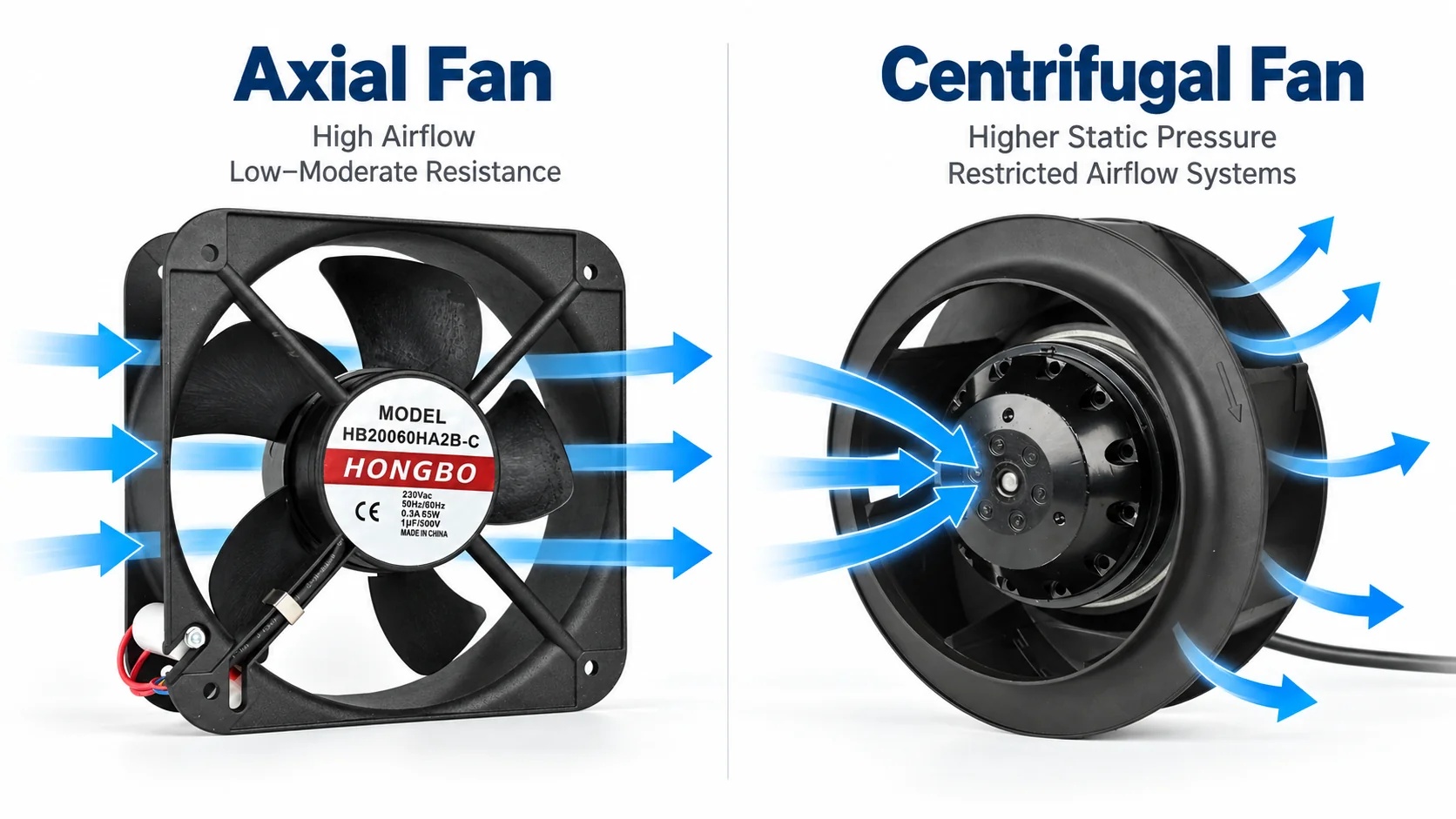
Axial Fans
Axial fans move air approximately parallel to the fan shaft.
They are widely used in:
- Electrical cabinets
- Control panels
- Refrigeration equipment
- Power equipment
- Industrial machinery
- HVAC systems
- Telecom equipment
Axial fans are particularly suitable when the application requires relatively high airflow with low-to-moderate resistance.
Centrifugal Fans
Centrifugal fans draw air into the center of the impeller and discharge it outward.
They are commonly used where greater pressure capability is needed, such as:
- Air handling equipment
- HVAC systems
- Air filtration systems
- Industrial machinery
- Heat exchangers
- Equipment with restricted airflow paths
The correct choice depends on the required combination of CFM and static pressure.
What Happens If Fan CFM Is Too Low?
If airflow is insufficient, heat may accumulate inside the equipment.
This can result in:
- Higher internal temperatures
- Reduced component efficiency
- Thermal shutdown
- Shorter electronic component life
- Unstable equipment operation
- Increased maintenance requirements
For this reason, cooling systems are normally designed with enough airflow capacity to handle expected operating conditions.
Can Fan CFM Be Too High?
More airflow is not always necessary.
An oversized fan can increase:
- Noise
- Power consumption
- Equipment size
- Fan cost
- Dust entering the system
The goal is therefore not to obtain the highest possible CFM.
The goal is to provide enough airflow at the required static pressure while maintaining acceptable temperature, noise, power consumption and reliability.
How Are Cooling Fan CFM Ratings Tested?
Fan airflow should ideally be measured under controlled test conditions.
Professional fan testing evaluates parameters such as:
- Airflow
- Static pressure
- Fan speed
- Power consumption
- Air density
- Fan efficiency
Industry standards such as AMCA 210 / ISO 5801 are commonly used as references for aerodynamic fan performance testing.
When comparing different industrial fans, reviewing the complete airflow and static-pressure curve provides much more useful information than comparing a single maximum CFM number.
How to Choose the Right CFM Cooling Fan
A practical fan-selection process can be summarized as:
Step 1 — Determine the required airflow
Estimate how much heat needs to be removed and the acceptable temperature rise.
Step 2 — Estimate system resistance
Consider filters, vents, heat exchangers, ducts and internal components.
Step 3 — Determine the required static pressure
More restrictive systems require greater pressure capability.
Step 4 — Check the fan curve
Confirm that the fan can provide the required CFM at the expected operating pressure.
Step 5 — Check electrical specifications
Confirm:
- Voltage
- Frequency
- Current
- Power
- AC/DC/EC motor type
Step 6 — Check mechanical requirements
Confirm:
- Fan dimensions
- Mounting dimensions
- Airflow direction
- Bearing type
- Connector or wire configuration
The final fan should meet both the airflow requirement and the system operating conditions.
Common CFM Questions
Is higher CFM better?
Not necessarily.
Higher CFM means more airflow, but the correct fan should provide the airflow your system actually requires. Excessive airflow may increase noise, power consumption and cost.
What does 100 CFM mean?
A rating of 100 CFM means the fan moves approximately 100 cubic feet of air per minute under the specified operating or test conditions.
How do I calculate CFM from air velocity?
Use:
CFM = Air Velocity (FPM) × Area (ft²)
Make sure the area represents the actual airflow cross section.
How do I convert CFM to m³/h?
Use:
m³/h ≈ CFM × 1.7
For example:
200 CFM ≈ 340 m³/h
Is CFM the same as airflow?
CFM is a unit used to express volumetric airflow.
Airflow can also be expressed using units such as:
- m³/h
- m³/s
- L/s
Does static pressure affect CFM?
Yes.
As airflow resistance and static pressure increase, the airflow delivered by a fan generally decreases.
Always check the fan’s performance curve when selecting a fan for applications with significant airflow resistance.
How many CFM do I need for a cooling fan?
It depends on your heat load, ambient temperature, acceptable temperature rise and system resistance.
There is no universal CFM value suitable for every cooling application.
Find the Right Cooling Fan for Your Application
CFM is one of the most important specifications when choosing a cooling fan, but it should always be considered together with static pressure, fan size, voltage, power consumption and operating environment.
Hongbo Motor manufactures a wide range of industrial cooling fans, including:
- AC Axial Fans
- DC Axial Fans
- EC Fans
- Centrifugal Fans
- External Rotor Fans
- Dual Voltage Fans
Multiple sizes, voltages, airflow ranges and wiring configurations are available for industrial cooling applications.
If you are not sure how much CFM your equipment requires, send us your:
- Required airflow
- Equipment dimensions
- Voltage
- Operating temperature
- Static pressure requirement
- Application
Our team can help you select a suitable cooling fan for your project.