Home / Engineering Resources / Fan Replacement
REPLACEMENT / CONFIGURATION REVIEW
Cooling Fan Replacement and Cross-Reference
Keep the original fan, its label and its installation details together when reviewing a replacement. Hongbo Motor’s published range includes AC, DC and EC axial fans, external rotor fans, centrifugal fans and accessories. Use these product families to identify candidates, then compare the candidate with the part and equipment you already have.

From the original part to an approved configuration
01 / DEFINE THE ORIGINAL
Bring the installed part into the review
An existing Hongbo part, a fan from another manufacturer and a modified OEM assembly need different reviews. Start with the complete original part number, a clear label photograph, the equipment supply and the available mounting space. If a detail is unknown, identify it as a question to resolve before the sample is approved.

For a repeat purchase, compare the full Hongbo suffix and any drawing or order reference with the previous supply. A frame number such as 12038 identifies a size family. It does not identify every electrical, bearing, impeller or termination option within that family.
For a cross-manufacturer review, send the original manufacturer’s complete reference and the available data sheet. Include special options printed after the main series number. A purchasing code on a machine builder’s label may need to be traced back to its approved component drawing.
For a changed installation, describe what is changing. A new connector, a different supply, a deeper filter or a revised panel can change the scope of the review. Route a configuration change through the OEM customization process so the quote, sample and production order refer to the same arrangement.
Take three useful photographs. Show the complete label, the frame and cable exit from the side, and the connector or terminals with their identification visible. Add an installation photograph showing the nearby cover, grille, filter and cable route. These views answer different questions and are more useful than repeated close-ups of the blades.
02 / MATCH THE REQUIREMENT
Compare five interfaces before choosing a candidate
01 / Mechanical fit
Record width, height and body depth, mounting-hole centres, hole type and available space on both sides. Include connector projection and the cable bend space. Compare the actual drawings rather than inferring a panel opening from the nominal frame size. Confirm airflow direction and the orientation of the mounting surfaces.
A candidate that fits the four holes can still interfere with a cover or leave an unsealed path around a filter. Record those differences before ordering an evaluation sample.
02 / Supply and electrical load
Identify AC, DC or the actual supply accepted by the selected EC part. For AC, record voltage and frequency. For DC, record the permitted supply range and polarity from the specific product documentation. Compare the equipment’s available current and starting requirements with the candidate’s documented values.
Treat dual-voltage wiring as a model-specific connection task. The original wire colours and the candidate’s wire colours do not establish equivalent connections. Request the current connection drawing for the complete candidate reference.
03 / Airflow in the actual air path
Keep airflow and static pressure together when an operating point is available. Note the filter, grille, heat sink and covers used to establish it. Compare curves for the required supply, frequency and speed setting. A catalogue’s maximum airflow and maximum pressure describe different ends of its curve.
If the original curve is unavailable, define what the equipment must achieve and how that will be measured. That might be a required installed airflow or a temperature limit at a named component under a specified load. Keep the candidate provisional until the agreed equipment test is complete.
04 / Controls and feedback
List the connector, pin assignments and any speed command, tachometer or alarm signals used by the equipment. Confirm their electrical requirements and expected behaviour from the two part-specific documents. A matching connector housing or the same number of wires does not establish a matching interface.
Include what the equipment should do when a signal is absent or a fan stops. Where a required signal or termination is not available on the catalogue version, ask for a configuration review rather than assuming it can be added.
05 / Environment and document scope
Record the fan inlet temperature, mounting orientation, duty cycle and relevant dust, moisture, condensation or oil exposure. Identify the destination market and the documents the equipment purchaser needs. A certificate, protection claim or test report for another suffix must not be treated as evidence for the proposed part without checking its scope.
03 / TWO PUBLISHED CONFIGURATIONS
A Hongbo example of why frame size is only the beginning
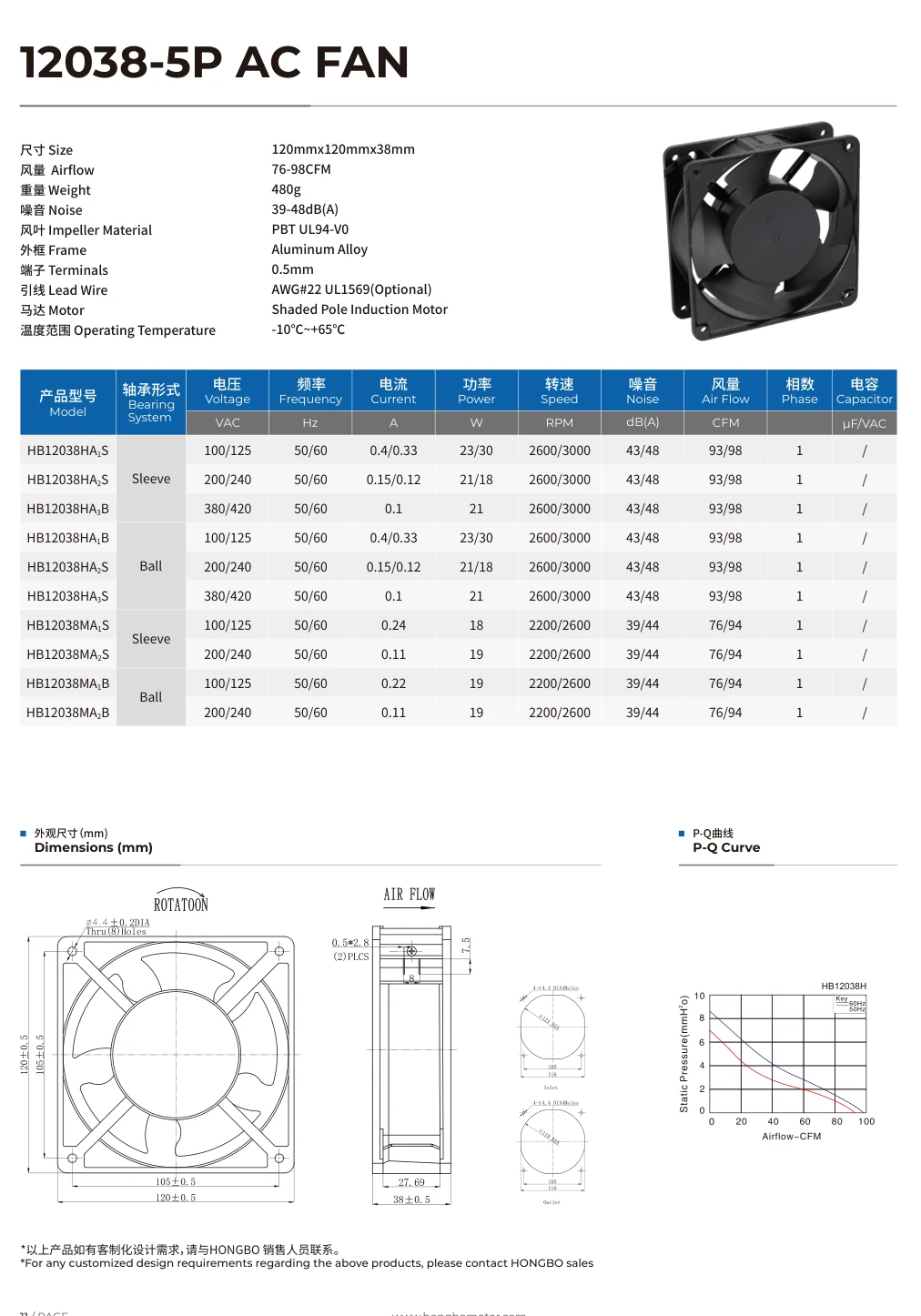
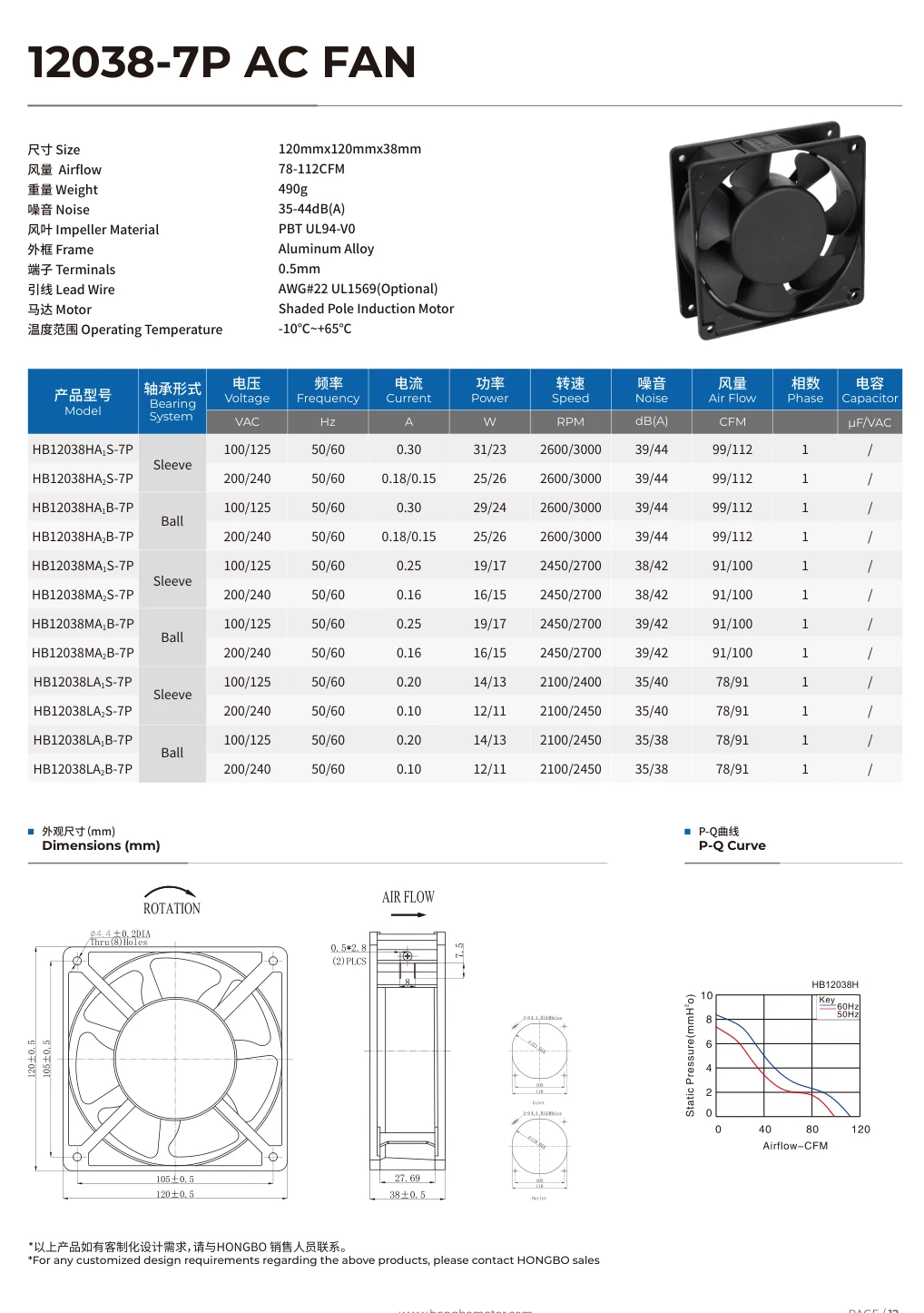
The local Hongbo catalogue records used in this example compare the 12038 five-blade and seven-blade families. The rows below use ball-bearing, 100/125 VAC versions, with 50/60 Hz values shown in that order. Check the latest catalogue and complete suffix during an actual review.
| Catalogue field | HB12038HA1B, five blades | HB12038HA1B-7P, seven blades |
|---|---|---|
| Catalogue frame family | 120 × 120 × 38 mm | 120 × 120 × 38 mm |
| Speed, 50/60 Hz | 2600/3000 RPM | 2600/3000 RPM |
| Catalogue airflow, 50/60 Hz | 93/98 CFM | 99/112 CFM |
| Catalogue noise, 50/60 Hz | 43/48 dB(A) | 39/44 dB(A) |
| Source | Printed page 11, 12038-5P | Printed page 12, 12038-7P |
These are catalogue values, not measurements from a customer installation. The shared frame and listed speed do not make the two versions interchangeable. Review their curves at the intended operating point, the drawings, the termination and the document scope before choosing a sample.
04 / CLOSE THE DIFFERENCES
Move from an identified original to an approved replacement
01
Identify the original and the reason for replacement
Provide the full reference and state whether the task is repeat supply, an unavailable part, a second source or a performance change. Keep the original data sheet and equipment drawing with the request. The output of this step is an identifiable original and a list of missing evidence.
02
Shortlist a compatible family
Use the known mounting envelope and supply to narrow the published range. Carry the operating point and required signals into the shortlist. Exclude a candidate as soon as it fails a required condition. A shortlist is a set of parts to assess, not an approved substitute list.
03
Close the document and interface differences
Compare the candidate drawing, connection information, curve and required compliance documents with the original. Record each item as matched, different or awaiting confirmation. Decide which differences can be accepted, which need an OEM configuration and which disqualify the candidate. Keep that decision with the sample request.
04
Define the sample and its acceptance checks
Specify the complete candidate reference, quantity, termination and drawing revision. Agree what will be measured and the acceptance value before testing. Use the actual panel, cable route, filter and controller where they affect the outcome. Missing model instructions or an unresolved interface should be settled before the relevant test proceeds.
05
Validate the sample in the equipment
Record mechanical fit, startup behaviour, the equipment’s thermal or airflow result and any required control or alarm function. Identify the supply, load, ambient conditions and sample tested. If it fails, return to the failed interface or operating requirement and review the candidate or configuration. Do not carry an unsuccessful result into a production approval.
06
Release a repeatable configuration
Retain the approved candidate part number, drawing revision, sample reference and test record. Link them to the first applicable purchase order. For a later change, identify the affected characteristic and repeat the relevant checks. A repeat order should refer to that approved configuration rather than the shortened family name.
05 / TAKE THE RECORD FORWARD
Prepare a replacement review file
Use the accompanying blank replacement worksheet to collect the original and candidate references, dimensions, supply, operating point, connector, signals and unresolved differences. Attach photographs and available drawings separately. A blank worksheet is a collection tool and does not represent a completed engineering assessment.
If the original label is unreadable, include the equipment identifier, a previous order or spare-part reference and measured dimensions. State which electrical details have been verified. The next step may be identifying the original requirement rather than recommending a fan immediately.
Questions before requesting a sample
Is a fan with the same dimensions a direct replacement?
Dimensions are the first check. Supply, installation clearances, curve, signals and required documents still need to match the equipment. Describe a part as approved only after the applicable differences and sample checks have been closed.
Can a higher-airflow fan solve an overheating problem?
Review the air path and the required operating point first. The replacement must also meet the available power, control, noise and mounting requirements. Verify the thermal result with the covers and filters installed.
Can you work from photographs alone?
Photographs can identify a label, connector or mounting issue. An operating range, wiring function, curve or certification scope may still need a document. Mark those items as unknown until they can be checked.
What should stay with a repeat order?
Keep the full approved reference, drawing and artwork revisions where applicable, sample approval and previous order reference. Explain any intended change before the next order is confirmed.
Send the original part and the requirement together
Send the complete original label, the installation information you have and the decision you need. Identify any hard limits on dimensions, supply, signals or the installed result. Use that information to request a candidate review and the documents needed for the next step.