Home / Engineering Resources / Product Changes
Can a 17050-C replace a 17050-7P?
Both listings show a nominal 172 × 150 × 51 mm frame. Follow one proposed change on an open order to see how the full suffix, the electrical record and the installed operating point affect approval.
Current configuration in this example
HB17050HA2B-7P
Configuration on the revised quote
HB17050HA2B-C
- Nominal frame
- 172 × 150 × 51 mm
- Listed supply
- 200 / 240 VAC
- Listed frequency
- 50 / 60 Hz
The airflow comparison reverses at 60 Hz
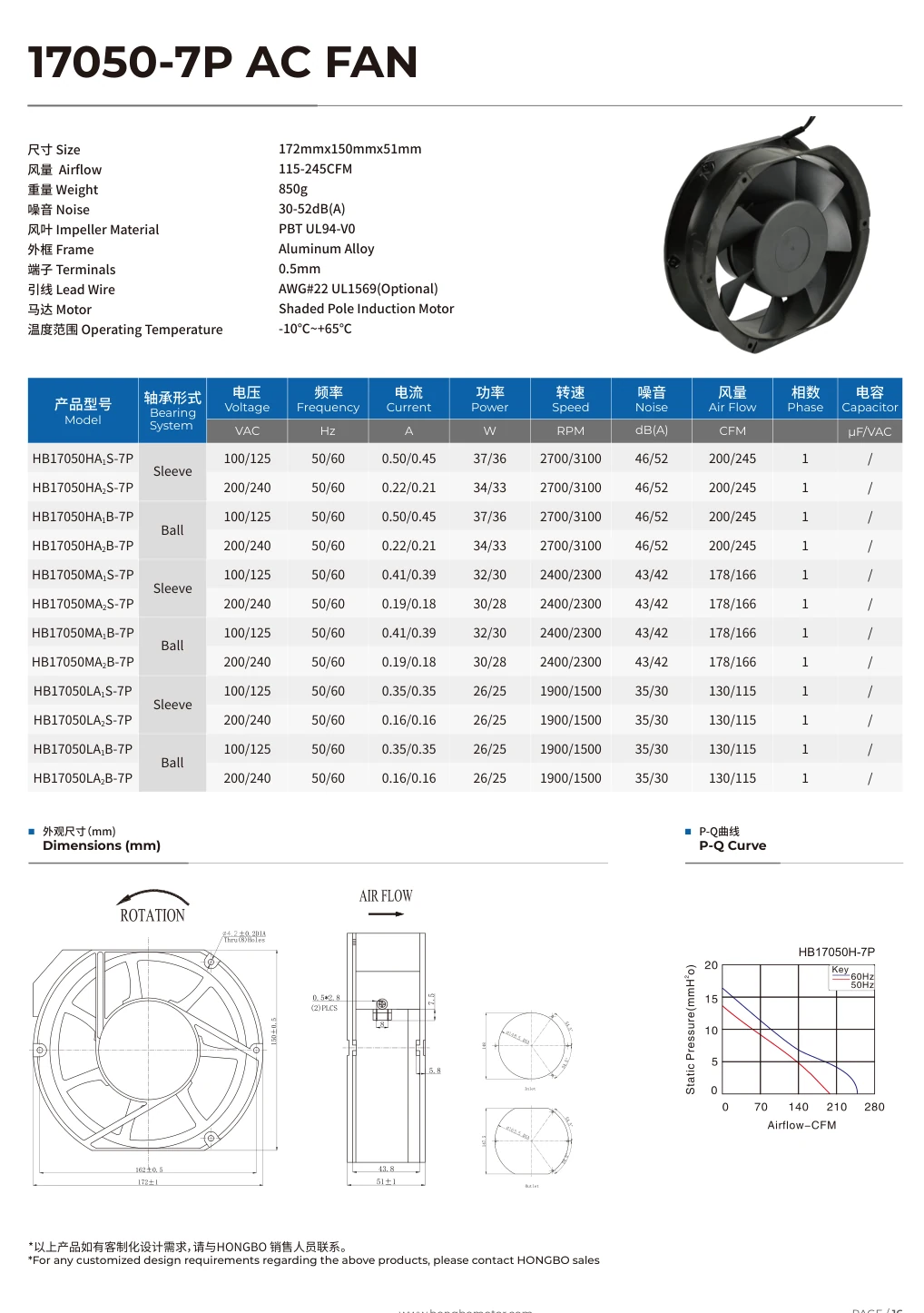
At 50 Hz the C listing is 15 CFM higher. At 60 Hz it is 20 CFM lower. The C listing also gives higher sound levels at both frequencies and specifies a 0.75 µF / 500 VAC capacitor. The electrical drawing and the operating curve for the exact variant are both relevant to the decision.
| Catalogue field | 7P | C |
|---|---|---|
| Capacitor entry | No value listed | 0.75 µF / 500 VAC |
| Current · A | 0.22 / 0.21 | 0.11 / 0.11 |
| Power · W | 34 / 33 | 25 / 27 |
| Speed · RPM | 2700 / 3100 | 2850 / 3350 |
| Sound · dB(A) | 46 / 52 | 51 / 58 |
| Airflow · CFM | 200 / 245 | 215 / 225 |
| Phase | 1 | 1 |
Read the exact rows on the 7P product page and the C product page. Use their rated conditions when comparing the figures. Ask for the curve for your supply and speed to see the airflow at the pressure imposed by your equipment.
A revised quote lists the C version
Suppose your filtered equipment was qualified with HB17050HA2B-7P. The revised quote for an open order lists HB17050HA2B-C. The available records show the same frame and supply entries with a different electrical record and different listed airflow.
The filter and grille add resistance. Check the requirement as an airflow and pressure pair in the intended enclosure. Use the model-specific curve to decide whether the C version merits an installed sample test.
Hold the substitution
Keep the approved suffix on the purchase order until the connections, mounting and installed performance have been approved for the new version.
What would clear the hold?
Keep the two suffixes on the same review record so the supplier, equipment engineer and buyer refer to the same parts. Record the exact revisions and the person approving each step.
Match the two controlled drawings
Request the electrical connection record for each suffix. Confirm the supply, connection and capacitor arrangement for the proposed part. Compare mounting centres, depth, air direction and lead clearance against the approved build.
Record the installed sample result
Use the actual filter, grille and supply in the equipment. Record the sample suffix, revision, airflow and static pressure at the agreed duty point. Include the applicable start, sound and temperature checks and the acceptance limits used.
Name the first released order
Record who approved the change and which first PO line, lot or date can use the proposed part. Confirm how to handle current stock and open orders. Carry the approved part and drawing revision into the purchase and receiving records.
Get a written answer on your exact suffix
For repeat supply, send the full label, last purchase reference, quantity and required delivery date. If you have a revised quote, label or notice, include a copy with the affected equipment and order lines.
Ask which drawing revision and order or lot the reply covers. For a phase-out, request the applicable notice, last-order and final delivery dates, and the status of your open orders. If a successor is offered, request its full part number and the evidence needed for the same review above.