
Cooling Fan Power and Operating Cost
Compare input watts at the same airflow and static pressure. Use the hours at each load to estimate annual electricity cost before sample approval.
Match the operating point before comparing watts
Use the same airflow, static pressure and thermal limit for both fans. Include the filter, grille, duct and panel in the setup. Every power reading needs an operating condition that another engineer can reproduce.
- Set the air requirement. Record airflow in CFM or m³/h and static pressure in Pa at the required airflow. If the system runs at two loads, retain a point for each load.
- Read power at the system input. Record real electrical watts with the supply and speed command. For a DC fan or a separate drive, use the same measurement boundary for both options and include conversion losses that the equipment actually pays for.
- Log the operating hours. Separate regular, peak and energized idle states. If a filter loads during use, check the applicable pressure, flow and watts for that state as well.
What the 12038 listings can tell you
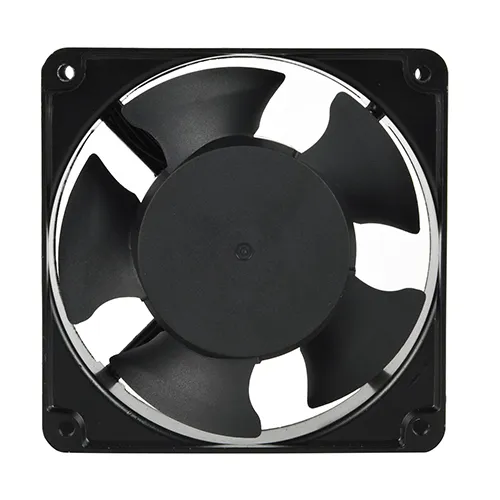
Both listings show a 120 × 120 × 38 mm frame. Start there for fit, then confirm the full electrical and airflow configuration for each one.
12038 five-blade AC
| Frequency | Input | RPM | Airflow |
|---|---|---|---|
| 50 Hz | 23 W | 2,600 | 93 CFM |
| 60 Hz | 30 W | 3,000 | 98 CFM |
These are two catalogue conditions for the listed AC model. Keep the frequency with each reading. To plan cabinet consumption, obtain input watts at the airflow and pressure the cabinet requires.
12038 EC
The EC listing describes 0–10 V or PWM compatibility and several output grades. Ask which suffix, input supply and speed interface match your equipment.
Request airflow, pressure and input watts together for the intended grade at your normal and peak settings. The public listing leaves airflow figures to the selected grade, so use your project readings in the cost estimate.
Estimate annual energy by operating mode
In this worked example, both candidates pass the same airflow, pressure and temperature requirements in each mode. The input watts, hours, fleet size and tariff below are assumptions for the calculation.
Annual kWh per fan
Add (input W × annual hours) for each mode and divide the total by 1,000.
| Operating mode | Hours per year | Fixed speed | Variable speed |
|---|---|---|---|
| Normal load | 3,000 | 20 W | 10 W |
| Peak load | 1,000 | 20 W | 18 W |
- Fixed speed
- 80 kWh
- $11.20 per fan per year
- Variable speed
- 48 kWh
- $6.72 per fan per year
At $0.14 per kWh, the difference is $4.48 per fan each year. For 200 installed fans on the same schedule, that is 6,400 kWh and $896.00 per year. Both options are assumed to draw no power outside the listed hours. Add idle watts and hours if the control stays energized.
Compare the installed cost after both samples pass
A lower power reading is useful when the candidate can meet the equipment’s thermal needs and keep the required airflow as operating conditions change.
- Check the equipment first
- Record airflow, pressure, temperatures, noise and input watts with the selected fan, filter and control. Qualify normal and peak load with the covers in their intended positions.
- Price the complete configuration
- Put the fan, added power supply or speed control, harness and bracket on the same quote basis. Compare the resulting cost with the annual electricity estimate at your hours and tariff.
- Keep the approved settings
- Carry the full part number, test conditions and controller settings into the approval record. If the fan suffix, filter or speed schedule changes, review the affected checks before releasing the revision.
Send your operating profile and model shortlist
Include the airflow and pressure for each mode, the operating hours, voltage and frequency, and the sample temperature and noise limits. If you have a label or report, include the full part number and any input power readings.